
SEO automation is no longer optional - it's essential for scaling your website's performance. By 2026, businesses are leveraging AI tools to handle tasks like keyword research, content optimization, technical audits, and search engine indexing. This shift saves time, reduces errors, and improves outcomes, with 65% of businesses reporting better results using AI and 10–20% revenue growth for those integrating it into workflows.
Here's what you can automate to stay competitive:
- Keyword Research: AI tools group related terms into clusters, helping you target broader topics instead of isolated keywords.
- Content Optimization: Platforms like IndexMachine ensure your pages are structured for both search engines and AI platforms like ChatGPT.
- Technical SEO Audits: Automation identifies and resolves issues like slow load times, broken links, and Core Web Vitals problems.
- Search Engine Indexing: Tools handle URL submissions and track indexing progress across Google, Bing, and AI systems.
- Local SEO: Automate business listing updates, review management, and schema markup to improve local rankings.
Automation doesn't replace human expertise - it complements it by handling repetitive tasks, letting you focus on strategy. With tools like IndexMachine offering lifetime plans starting at $12.50, automating your SEO efforts has never been easier.
If you are choosing between a full SEO suite like Indexly and a focused indexer, our IndexMachine vs Indexly page walks through the trade-offs.
AI SEO in 2025: The Complete Automation Playbook (That Nobody's Talking About)
Step 1: Automate Keyword Research with AI Tools
Gone are the days when keyword research meant spending hours manually sifting through data. In 2026, AI has taken over this task, leveraging Natural Language Processing (NLP) to grasp the context and relationships between words. This shift allows tools to move beyond simple keyword strings and focus on broader, more meaningful concepts. These AI tools analyze Search Engine Results Pages (SERPs) at scale, categorizing user intent into four main types: informational, commercial, transactional, and navigational.
This evolution changes the game. Instead of zeroing in on individual keywords, AI now clusters semantically related terms by analyzing overlapping ranking URLs - a method called automated keyword clustering. This strategy builds topical authority rather than chasing isolated search terms. As Aleyda Solis, International SEO Consultant at Orainti, explains:
"LLMs represent the most significant innovation in search since Google became a household name."
Using AI to Find Keywords
AI-powered tools take keyword research further by generating prompts tailored to specific personas. These tools anticipate what your audience might search for, based on their roles, goals, and challenges. For instance, instructing ChatGPT to "act as a coffee blogger" can uncover niche long-tail keywords that traditional tools might miss. AI also enhances keyword gap analysis by automatically identifying areas where competitors outrank you and highlighting untapped opportunities across domains or individual pages.
Some tools even monitor brand mentions and citations across multiple large language models (LLMs), such as ChatGPT, Claude, Perplexity, and Google's AI Overviews. For example, Marketer Milk reports gaining around 5,000 visitors each month from LLM-based search features.
To refine your keyword research, start with affordable LLMs for brainstorming, then cross-check these ideas with established SEO tools to validate search volume and competition levels. Once you've built a keyword list, use clustering tools like SurferSEO or ClusterAI to group related terms into content clusters. Each cluster can guide the creation of a comprehensive page, forming the backbone of your SEO strategy.
Adding Keywords to Your SEO Strategy
Once you've gathered AI-driven insights, it's time to weave them into a focused SEO plan. Automating keyword clustering by search intent can help you avoid content cannibalization, where multiple pages compete for the same keyword rankings.
Before finalizing, always run a "human layer" check. Search your primary keyword in an incognito browser to ensure the AI's predicted intent aligns with real-world results. Then, prioritize your keyword clusters based on their relevance to your business goals, search volume, and ranking difficulty. Assign primary keywords to H1 tags and meta descriptions, and use AI-recommended secondary terms for alt tags and internal links. To track traffic from AI-driven sources like ChatGPT and Perplexity, consider setting up custom regex filters in Google Analytics 4.
As Concoctions.ai aptly puts it:
"The future of SEO isn't human vs. machine. It's the human plus the machine."
This AI-powered approach not only streamlines keyword research but also sets the stage for the advanced content and technical strategies discussed in later sections.
Step 2: Optimize Content with IndexMachine

Once your content is created, the next big hurdle is making sure it gets noticed by search engines and AI platforms. Automation can help streamline this process, cutting manual tasks by 30% and slashing the time it takes to publish by half. Tools like IndexMachine, which uses predictive algorithms to assess page indexability, make this process far more efficient. By incorporating advanced tools like IndexMachine, you can reduce the manual effort typically associated with SEO and let machine-driven processes handle the heavy lifting.
Writing SEO-Friendly Content with AI
AI writing tools have become essential for creating content that aligns with search intent. These tools can suggest related subtopics, evaluate how well your content matches user intent, and even provide intent alignment scores. They also perform content gap analyses, helping you identify areas that need improvement quickly. With the rise of Generative Engine Optimization (GEO) and Answer Engine Optimization (AEO), your content must be structured in a way that allows AI agents to easily interpret, understand, and even cite it.
Using IndexMachine's Page Insights to Improve Content
IndexMachine offers a range of features to enhance your content's visibility. For instance, its Page Inspect tool pinpoints technical SEO issues that might be hindering your site's performance. By analyzing site data alongside search engine bot behavior, it generates daily prediction models for every URL on your site. Specific signals like page freshness, internal link depth, and content similarity are evaluated to identify and address crawl efficiency problems.
The LLM Indexability tools take it a step further by tracking whether your site is discoverable and referenced by AI platforms like ChatGPT, Perplexity, and Gemini. This is critical because traditional SEO metrics don't account for traffic driven by AI. The Instant Indexing report helps you locate pages flagged as "Crawled – Not Indexed" or "Discovered – Not Indexed", allowing you to submit them for immediate indexing. With Auto-indexing, the AI can monitor page statuses and automatically submit new content to search engines as it's published. Finally, the visibility reports give you detailed metrics on impressions, clicks, and click-through rates (CTR) for your keywords, offering clear insights into how well your optimized content is performing over time.
This automated approach to content optimization lays the groundwork for more in-depth technical audits in the next phase.
Step 3: Run Technical SEO Audits with Automation
Just like keyword research and content optimization, automating technical audits is a game-changer for your SEO strategy. Even the most polished content can be undermined by technical issues. For example, slow load times are a major problem - 40% of visitors abandon websites that take over three seconds to load, while 47% expect pages to load in under two seconds. These delays can drag down your rankings fast. Automation steps in to turn what used to be a tedious, manual process into a system that continuously monitors your site and catches issues before they impact your traffic.
Common Technical SEO Issues to Automate
Some technical issues are more damaging than others, and automation can help tackle the most pressing ones. Crawl and indexation blockers - such as "Discovered – currently not indexed" statuses, robots.txt conflicts, and redirect chains - can waste your crawl budget and hurt your site's visibility. Then there are Core Web Vitals, which focus on metrics like Largest Contentful Paint (LCP), Cumulative Layout Shift (CLS), and Interaction to Next Paint (INP). These directly affect user experience and, by extension, your rankings. Automation tools are also great for spotting duplicate content (anything with 85% or more similarity), broken links, 404 errors, and slow Time to First Byte (TTFB) caused by render-blocking scripts or unoptimized images.
"AI technical SEO audit tools compress weeks of diagnostics into minutes." - Eric Siu, Founder, Single Grain
By automating these processes, you can continuously monitor your site's health instead of relying on outdated quarterly reviews.
Using Tools and Reports for Technical SEO
Once you've identified key technical issues, the next step is using automated tools to both monitor and resolve them. Platforms like IndexMachine simplify this process by consolidating data from crawlers, page speed tests, and server logs into a single scoring model. This model prioritizes fixes based on their SEO impact and the effort required to implement them. You can even set up automated alerts - through Slack or email - to get real-time notifications for issues like new 404 errors or dips in site speed.
These tools go beyond just flagging problems. They collect data through automated crawls, identify patterns, and prioritize fixes based on revenue impact. They also suggest actionable solutions, complete with code snippets, and validate your changes with follow-up crawls. By addressing systemic issues rather than isolated page problems, you can make meaningful improvements across your entire site.
And here's the kicker: by 2024, 49% of enterprise tech leaders had fully integrated AI into their core strategies. Early adopters of these automated solutions have already seen a 10–20% boost in revenue from their efforts. These tools aren't just about saving time - they're about staying ahead in a competitive landscape.
Step 4: Automate Search Engine Indexing with IndexMachine
Speeding up search engine indexing is a critical part of any automation strategy, especially when it comes to SEO. Without proper indexing, even the most well-crafted content can go unnoticed. While manual submissions through tools like Google Search Console or Bing Webmaster Tools can be tedious and unreliable, IndexMachine simplifies the process. It automates submissions and tracking, saving you time and ensuring your pages get the visibility they deserve.
Setting Up IndexMachine for Google, Bing, and LLMs
IndexMachine integrates directly with Google Search Console and Bing Webmaster Tools using API connections, creating a seamless link to their databases. But it doesn't stop there - IndexMachine also supports submissions to Large Language Models (LLMs) such as ChatGPT, which are playing a growing role in digital visibility as of 2026. You have the flexibility to enable or disable indexing for specific search engines on a domain-by-domain basis, giving you full control over where your content appears.
Configuring Auto-Submission to Search Engines
By activating Instant Indexing or Auto-indexing, you can address common issues like "Discovered – Not Indexed" errors. This approach is much faster and more reliable than manually submitting URLs through Google Search Console. Depending on your plan, IndexMachine can automatically submit up to 20 URLs per day to Google and up to 200 to other search engines. The system prioritizes pages based on factors like how recently they were updated and their internal link depth, ensuring that your most important content gets indexed first. With auto-submission enabled, you'll also receive daily updates to keep track of your progress effortlessly.
Tracking Indexing Progress with Daily Reports
IndexMachine provides a real-time view of your site's indexing performance through visual charts and detailed daily reports. For every URL, the platform uses a prediction model to estimate the likelihood of successful indexing, considering elements like page freshness and internal link structure. By analyzing crawl data, server logs, and search console metrics, it can pinpoint crawl efficiency issues before they hurt your rankings. Daily reports include insights on which pages were indexed, their coverage status, the last crawl date, and alerts for any 404 errors that need fixing. With this level of tracking, you'll always know exactly how your indexing efforts are performing.
Step 5: Automate Local SEO and Set Up Alerts
Local SEO plays a crucial role in boosting your website's visibility, especially when combined with advanced content and technical automation. It focuses on the unique challenge of keeping your business information accurate and consistent across a variety of platforms.
Managing platforms like Google Business Profile, Apple Maps, and Bing manually can be exhausting and time-intensive. Automation simplifies this process, cutting the task down to just 30 minutes. By automating NAP (Name, Address, Phone) consistency across over 100 platforms, you can increase your Google Business Profile views by 42%.
Improving Local Search Rankings
AI-powered tools make local SEO much more efficient by syncing your business data across major platforms using API connections. Need to update holiday hours or location details? Automated systems can push those changes to all platforms simultaneously. They also scan for duplicate listings and errors, fixing them quickly. With traditional search volume expected to drop by 25% by 2026, using LLM-ready schema markup ensures AI search engines like ChatGPT and Gemini can accurately extract your business details.
Automation also improves review management. Sending automated review requests via SMS or email right after a customer interaction helps you maintain a steady flow of reviews. AI tools can even craft personalized, brand-consistent replies to reviews, saving you hours of manual work while keeping your engagement high.
This local SEO strategy naturally extends to detecting and addressing potential issues before they escalate.
Creating Alerts for Local SEO Problems
Real-time alerts are an essential complement to local ranking automation. Tools like IndexMachine monitor your site's technical health around the clock, identifying issues that could harm your local search performance. For instance, you can set up alerts to notify you via email or Slack if 404 errors or broken links exceed a certain threshold. These alerts ensure problems are caught early - whether it's a competitor trying to modify your business hours or marking your location as permanently closed on your Google Business Profile, you'll be notified immediately.
Another critical feature to enable is traffic anomaly detection. A sudden drop in organic traffic might indicate an algorithm update or a technical issue that needs immediate attention. Automating these monitoring tasks not only protects your local SEO efforts but also gives you more time to focus on strategic initiatives.
As Sam, a Startup Engineer and Builder, aptly puts it:
"Automation is a tool, not a replacement. Use it to free time for the work only humans do best."
IndexMachine Pricing Plans: Which Plan to Choose
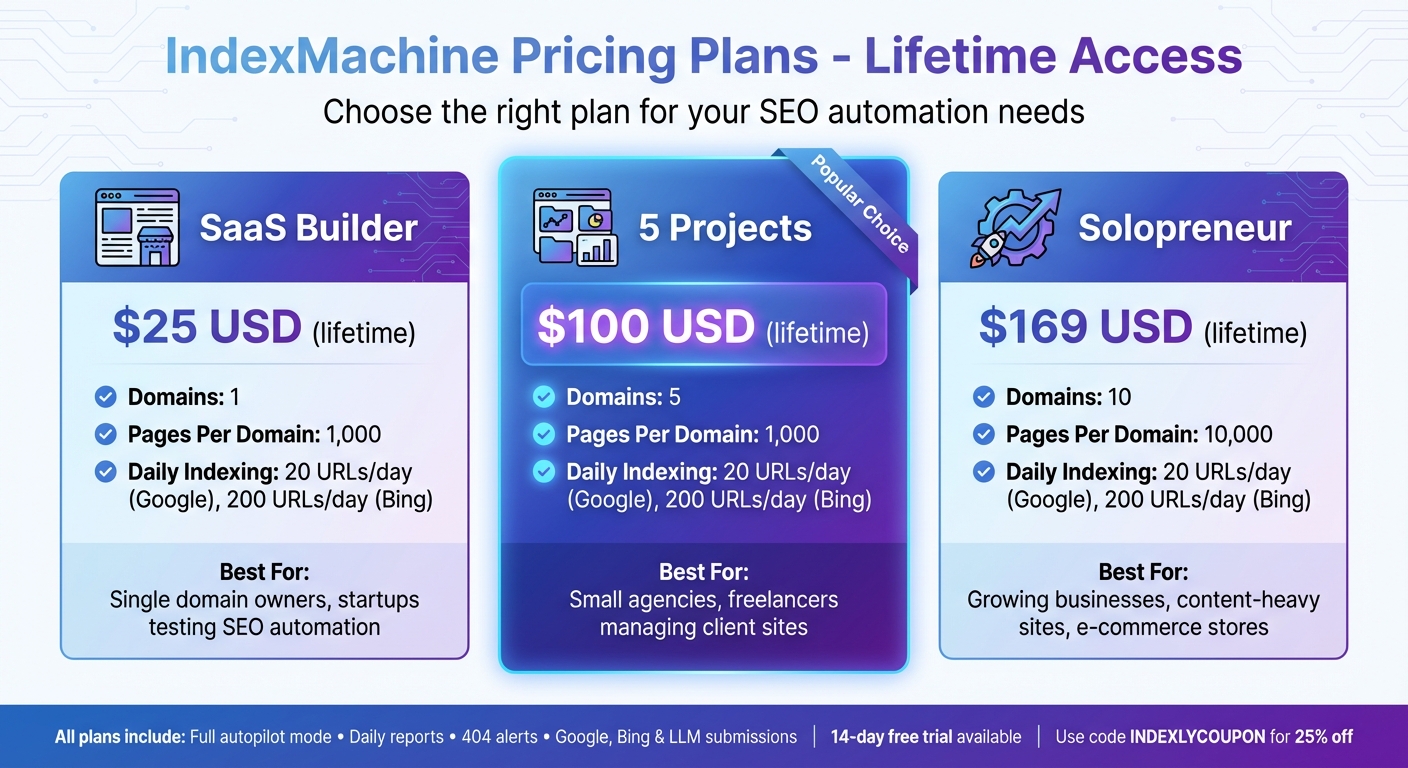
Finding the right plan depends on your SEO automation needs. IndexMachine offers three lifetime pricing tiers, tailored for both single and multiple domains.
All three tiers are currently at beta pricing (the entry plan is $12.50 instead of $25). The SaaS Builder tier is the cheapest way to test the platform on a single domain.
IndexMachine Pricing Plans Compared
| Plan Name | Price (USD) | Domains | Pages Per Domain | Daily Indexing Limits | Best For |
|---|---|---|---|---|---|
| SaaS Builder | $12.50/lifetime | 1 | 1,000 | 20 URLs/day (Google), 200 URLs/day (Bing) | Single domain owners, startups testing SEO automation |
| 5 Projects | $50/lifetime | 5 | 1,000 | 20 URLs/day (Google), 200 URLs/day (Bing) | Small agencies, freelancers managing client sites |
| Solopreneur | $84.50/lifetime | 10 | 10,000 | 20 URLs/day (Google), 200 URLs/day (Bing) | Growing businesses, content-heavy sites, e-commerce stores |
All plans come with full autopilot mode, daily reports, 404 page alerts, and automated submissions to Google, Bing, and LLM platforms like ChatGPT. The main differences lie in the number of domains and the page capacity per domain.
If you're running a single domain, the SaaS Builder plan is a straightforward choice. For those managing multiple client websites, the 5 Projects plan offers the flexibility to handle up to five domains. And if your business relies on extensive content or operates multiple e-commerce sites, the Solopreneur plan - with its 10,000-page capacity per domain - has you covered.
When choosing a plan, consider your current needs and future growth. For instance, if you're dealing with pages flagged as "Discovered – Not Indexed", these plans ensure quick indexing and streamlined SEO automation. With the right plan, you can maximize efficiency and focus on scaling your SEO efforts.
Conclusion: Simplify Your SEO with Automation
Automation in SEO works hand-in-hand with human expertise by taking over routine, time-consuming tasks. Processes like technical audits, indexing, and keyword clustering can be automated, giving you more time to focus on strategy and creative decisions that truly benefit from human insight.
The impact of AI-powered automation is clear: it can reduce manual content tasks by 30%, cut time-to-publish by 50%, and resolve technical issues up to 28% faster. On top of that, 65% of businesses have reported improved results when integrating AI into their SEO workflows. This means more bandwidth for creative direction and strategic oversight.
Key Takeaways for Automating SEO in 2026
To sum up, here are the essential points for leveraging SEO automation effectively in 2026:
- Automate repetitive, low-strategy tasks. Things like technical monitoring, indexing, and identifying content gaps are perfect for automation. Tools such as IndexMachine can handle tasks like submitting URLs to search engines and AI platforms, while you stay focused on maintaining your brand's voice and content quality.
"Automation is a tool, not a replacement. Use it to free time for the work only humans do best." - Sam, Startup Engineer & Builder
As Generative Engine Optimization gains traction, structuring content for AI agents (like ChatGPT and Perplexity) becomes just as important as optimizing for traditional search engines. Automation can help track your visibility across these platforms while human oversight ensures E-E-A-T principles and factual accuracy are upheld. With tools like IndexMachine offering lifetime pricing from $12.50, there's no reason to stick to outdated, manual SEO methods.
FAQs
How does AI help automate keyword research for SEO?
AI is transforming how keyword research is done, making the process quicker and more intuitive. Instead of manually combing through endless data, AI-powered tools can analyze user behavior, trending topics, and search intent to generate keyword ideas in just minutes. These tools go beyond individual terms by grouping keywords into topical clusters, which helps you focus on broader themes. This approach increases your chances of ranking for multiple related searches simultaneously.
What's more, AI leverages historical data and competition metrics to pinpoint high-value keywords - those with strong search potential and manageable levels of competition. As trends shift, these tools automatically refresh keyword lists, keeping your campaigns aligned with current search behaviors without requiring extra manual input. By seamlessly integrating keyword research into larger SEO workflows, AI automates tasks like content planning and performance tracking, saving you time while sharpening the accuracy of your SEO strategy heading into 2026.
How does IndexMachine help improve content optimization?
IndexMachine is a game-changer when it comes to making content optimization easier and more efficient for your website. With its AI-powered tools and automation features, it handles essential tasks like keyword research, content analysis, and metadata adjustments. This means your content stays in line with the latest SEO practices, all while saving you a ton of time and effort.
Using advanced machine learning algorithms, IndexMachine pinpoints ways to enhance your content's relevance and visibility, giving you a better shot at ranking higher in search results. Whether you're focusing on matching search intent or fine-tuning technical aspects, IndexMachine delivers practical insights to help you strengthen your online presence.
What are the benefits of automating technical SEO audits for my website?
Automating technical SEO audits can save you a ton of time and effort by quickly pinpointing issues like crawl errors, indexation gaps, Core Web Vitals concerns, and missing structured data. Instead of manually combing through your site for hours, automation tools continuously monitor and flag problems early, giving you the chance to address them before they hurt your rankings.
This method not only minimizes human error but also delivers more consistent and accurate results by pulling data from multiple sources like crawlers and server logs. Automated audits help you tackle key factors like page-load speed and overall site health - both crucial for maintaining strong rankings and improving the user experience. Plus, automation makes scaling a breeze. You can easily keep an eye on thousands of URLs without adding to your workload, making it an essential tool for efficiently growing your online presence.